Preserving Indigenous Digital Heritage
Published 12 May 2026
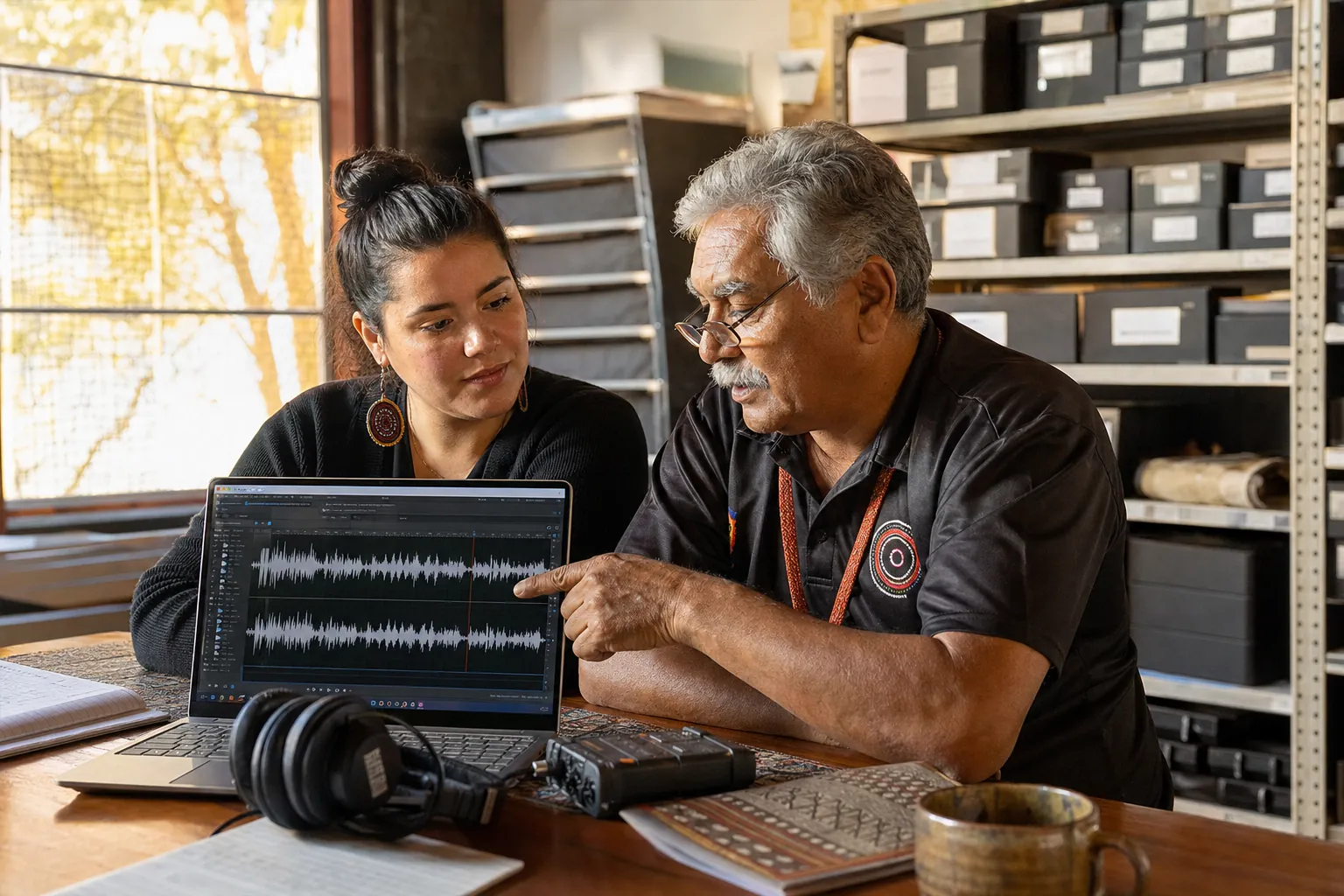
When elders in remote communities record stories, songs, and ceremonial knowledge on smartphones, they are participating in a form of digital heritage preservation. When language centres develop apps that teach young people vocabulary from their grandparents’ generation, they are deploying technology in the service of cultural continuity. These everyday acts of digital creation and transmission are the foundation of Indigenous digital heritage work in Australia today.
Community Control as the Starting Point
The central principle in Indigenous digital heritage work is community control. This is not merely an ethical preference — it is a structural requirement for work that serves First Nations communities rather than extracting from them. Communities that control their own digital archives determine what is stored, who can access it, under what conditions, and for what purposes. They set the metadata standards that reflect their own knowledge categories rather than imposing external classificatory frameworks.
The contrast with historical practice is stark. For most of the 20th century, recordings of First Nations language, ceremony, and cultural life were made by outside researchers, deposited in external institutions, and made accessible on institutional terms. Many of these recordings were created without meaningful consent; many are held today in archives physically and intellectually distant from the communities whose heritage they document.
Digital Language Revitalisation
Australia’s Aboriginal and Torres Strait Islander languages face a severe survival crisis. Of the estimated 250 to 300 distinct languages spoken at the time of European settlement, the majority are now severely endangered. First Languages Australia — the national peak body for First Nations language work — estimates that only about 40 languages are still spoken by significant numbers of people across all age groups.
Digital tools have become central to language reclamation and revitalisation efforts. Voice recordings made by elderly speakers — preserved on digital media and distributed through secure platforms accessible to community members — are being used by younger generations to learn sounds, vocabulary, and grammar that no living teacher can provide from memory alone.
Apps developed specifically for Indigenous language learning — including FV (FirstVoices), developed by the First Peoples’ Cultural Council in Canada and widely used in Australia — allow communities to build their own language databases and deploy them through mobile interfaces. Learners can hear recordings of elders pronouncing words, see associated images, and practice through simple games and quizzes.
Mukurtu and Community-Controlled CMS
The Mukurtu platform represents a significant contribution to community-controlled digital archive infrastructure. Developed originally by Kim Christen and Craig Dietrich for the Warumungu community in the Northern Territory, Mukurtu embeds Indigenous cultural protocols at the database level rather than implementing them as optional access controls layered over a generic system.
A Mukurtu installation can enforce rules such as: “this item may only be viewed by initiated men,” “this item may only be viewed by women,” or “this item is restricted to community members.” These rules are configured by community administrators and enforced by the system — they do not rely on external users voluntarily complying with advisory notices.
Several dozen Australian First Nations communities and organisations have deployed Mukurtu installations, often in partnership with university researchers or state libraries who provide technical support while leaving governance of the archive firmly with the community.
Digital Repatriation: Copies Returning Home
Physical repatriation of cultural objects from overseas museum collections is a slow, complex process. Digital repatriation — the return of digitised records and copies of materials held in external archives — offers a complementary pathway that can be achieved faster and at scale.
The British Library, the Smithsonian, and several European ethnographic museums hold recordings of Australian First Nations language and cultural practice made by early anthropologists and missionaries. Digitisation of these collections, followed by their distribution to descendant communities through secure platforms, has allowed communities to reconnect with recordings of ancestors they have never heard speak.
The Ara Irititja project, operated by the South Australian government in partnership with Anangu communities, has been returning digitised photographs, recordings, and documents to remote communities for over two decades. Community members have described the experience of seeing photographs of grandparents and great-grandparents — people they knew only through family stories — as profoundly significant.
Intellectual Property and Cultural Ownership
The legal framework governing Indigenous cultural and intellectual property in Australia remains inadequate for the digital environment. Current copyright law does not recognise communal or perpetual ownership of cultural expression — two characteristics central to First Nations understandings of cultural property. A recording of a song performed during ceremony is, legally, owned by whoever made the recording; the community from whose culture the song comes has no automatic legal claim.
The Local Contexts initiative — developed with significant input from Australian First Nations communities and institutions — offers a practical supplement to this inadequate legal framework. Its Traditional Knowledge (TK) Labels and Biocultural (BC) Labels are metadata standards that communities can attach to digitised material to communicate culturally appropriate usage conditions. These labels are increasingly recognised by Australian and international collecting institutions as a meaningful expression of community rights, even where they lack direct legal enforceability.
Practical Support for Community Digital Projects
Communities undertaking digital heritage work face practical challenges that require sustained institutional support: digital literacy training, equipment maintenance, broadband connectivity, and technical expertise for software configuration and troubleshooting. In remote areas with limited connectivity, these challenges are compounded by the difficulty of maintaining systems that depend on reliable internet access.
State libraries in Western Australia, Queensland, and the Northern Territory have developed community digital archive support programmes that provide training, equipment grants, and ongoing technical assistance. The National Library of Australia’s community heritage grants programme funds digitisation equipment for community organisations, including First Nations language centres and community cultural bodies.
These support structures are essential. The principle of community control is meaningless if communities lack the practical capacity to exercise it.