Why Digitisation Matters for Australia's Cultural Sector
Australia holds an extraordinary breadth of cultural material: Indigenous artefacts, colonial-era documents, natural history specimens, photographic archives, and more. Many of these objects are fragile, geographically inaccessible, or at risk from environmental damage. Digitisation offers a means of both safeguarding the physical record and making it accessible to researchers, educators, and the public — regardless of location.
The National Library of Australia's Trove platform stands as one of the most ambitious digitisation efforts in the Southern Hemisphere, providing free public access to millions of newspaper pages, photographs, maps, and manuscripts. Trove's model — aggregating digitised content from hundreds of contributing institutions — has become a reference point for federated approaches to cultural digitisation.
Core Digitisation Technologies
Modern digitisation programmes deploy a range of capture technologies depending on the object type, required resolution, and available budget.
Flatbed and Overhead Scanning
For two-dimensional material — documents, photographs, maps, and artwork on paper — high-resolution flatbed scanners remain the workhorse of mass digitisation pipelines. Overhead planetary scanners allow bound volumes to be captured without opening them fully, reducing stress on fragile spines. Cultural institutions processing large volumes of archival material often invest in automated document feeders and robotic page-turning systems to increase throughput.
Photogrammetry
Photogrammetry — deriving three-dimensional geometry from overlapping photographs — has transformed how institutions approach three-dimensional objects. By taking dozens or hundreds of images from different angles and processing them with Structure-from-Motion (SfM) software, conservators can produce detailed 3D models of ceramics, sculptures, tools, and archaeological finds. The models can be published online, used in printed reproductions, or referenced during conservation treatment planning.
The Museum Victoria's digitisation programme has applied photogrammetry extensively to its natural history collections, creating publicly accessible 3D models of specimens that would otherwise be accessible only to visiting researchers.
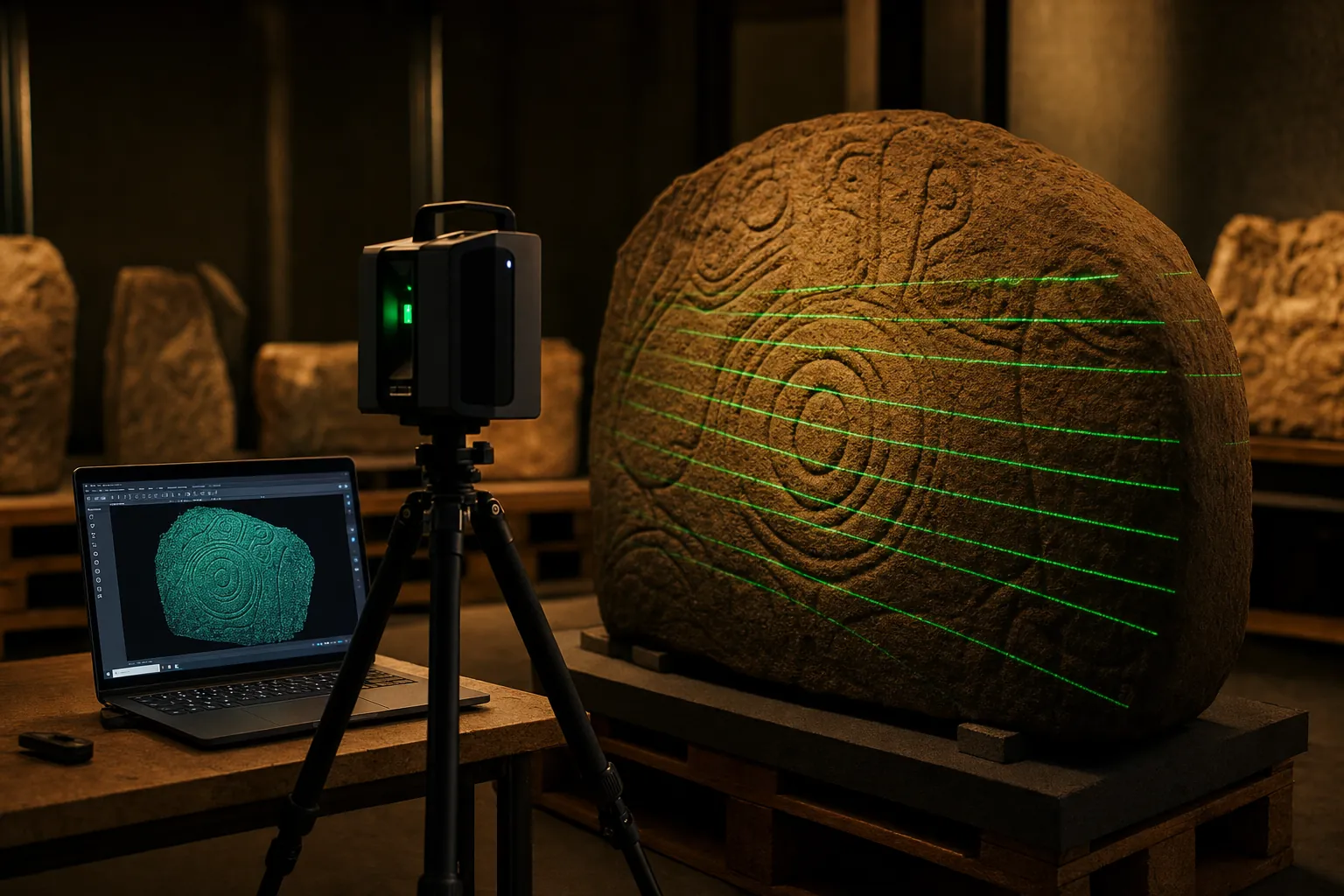
3D Laser Scanning
Where photogrammetry relies on texture-rich surfaces, structured light and laser scanning systems excel with reflective, featureless, or complex geometries. A triangulating laser scanner projects a pattern of light onto an object and measures the deformation of that pattern to extract surface coordinates with sub-millimetre accuracy. These systems are routinely used in the conservation of stone sculpture, metalwork, and architectural fragments.
The Australian Institute of Aboriginal and Torres Strait Islander Studies (AIATSIS) has used 3D scanning alongside community consultation to create digital surrogates of culturally sensitive objects, enabling broader access while supporting the physical return or restricted display of originals.
Multispectral Imaging
Beyond the visible spectrum, multispectral imaging systems capture reflectance data across ultraviolet and near-infrared wavelengths. This reveals hidden text beneath later overwriting (palimpsests), faded inks, underdrawings in paintings, and damage invisible to the naked eye. The Australian War Memorial and State Library of New South Wales have applied multispectral imaging to colonial documents and historical maps to recover content that conventional photography cannot capture.
Mass Digitisation Pipelines
Individual institutions cannot address the scale of Australia's undigitised cultural holdings alone. Mass digitisation partnerships — where large commercial digitisation vendors operate in-house facilities at cultural institutions — have become increasingly common. Google's partnership with selected Australian institutions for newspaper digitisation, and the ongoing work of the Internet Archive with local libraries, demonstrate how collaborative models can accelerate throughput without requiring institutions to build permanent internal infrastructure.
The key challenge in mass digitisation is quality control at volume. Automated image analysis tools now flag under-exposed captures, pages with excessive curl, or focus failures before they reach the metadata workflow, significantly reducing manual review time.
Metadata, Interoperability, and Discoverability
A digitised object without metadata has limited research value. Australia's cultural sector has largely converged on Dublin Core and MODS (Metadata Object Description Schema) for descriptive metadata, with growing adoption of IIIF (International Image Interoperability Framework) to make digitised content usable across different platforms without re-hosting.
IIIF allows cultural institutions to publish their digitised content as manifests — structured JSON files describing images, their relationships, and associated metadata. Researchers and educators can then load these manifests into any IIIF-compatible viewer, annotate them, compare images from different collections side-by-side, and share deep links to specific regions of interest. The National Library of Australia, State Library Victoria, and Powerhouse Museum are among Australian institutions publishing IIIF endpoints.
Ethical Dimensions of Digitisation
Digitisation raises complex questions that are particularly acute in Australia's context of colonial history and living First Nations cultures. Who controls access to digitised cultural material? How should sacred or secret objects be handled in digital form? What obligations do institutions have to communities of origin?
The principle of Indigenous cultural and intellectual property rights asserts that communities retain sovereignty over their cultural heritage, including its digital representations. Practical responses include implementing access tiers — where certain digitised materials are visible only to authenticated community members — and developing community-controlled portals that operate independently of mainstream institutional databases.
AIATSIS's Code of Ethics for Aboriginal and Torres Strait Islander Research provides guidance for institutions navigating these questions, emphasising free, prior, and informed consent and the primacy of community benefit in any digitisation project involving First Nations material.
Long-Term Digital Preservation
Creating a digital file is only the beginning of the preservation challenge. Digital objects require ongoing active management: format migration as standards evolve, storage redundancy across geographically distributed systems, and regular fixity checks to detect and correct data corruption.
Australia's cultural institutions predominantly use OAIS (Open Archival Information System) as the conceptual framework for digital preservation, with systems such as Rosetta (National Library of Australia), DSpace, and Fedora serving as repository platforms. The Australian National Data Service (ANDS) and Research Data Australia initiatives have helped standardise approaches to persistent identifiers — including DOIs and ARKs — which ensure that links to digitised content remain resolvable even as URLs and institutional structures change.
Looking Forward
The next frontier in collection digitisation involves artificial intelligence-assisted processing: automated handwriting transcription using tools like Transkribus, machine learning classification of photographic subjects, and natural language processing for bulk metadata enrichment. Several Australian institutions are piloting these approaches in partnership with university researchers, with the aim of making the rich contextual information embedded in archival collections discoverable at a scale that human cataloguers alone could never achieve.
Robotics is also advancing rapidly. Prototype systems capable of autonomously digitising entire shelf-metres of bound volumes — opening each book, positioning it under a camera array, capturing both pages, and closing it again — are moving from laboratory demonstrations toward institutional deployments. At scale, these systems could address the backlog of undigitised holdings in a fraction of the time required by current workflows.