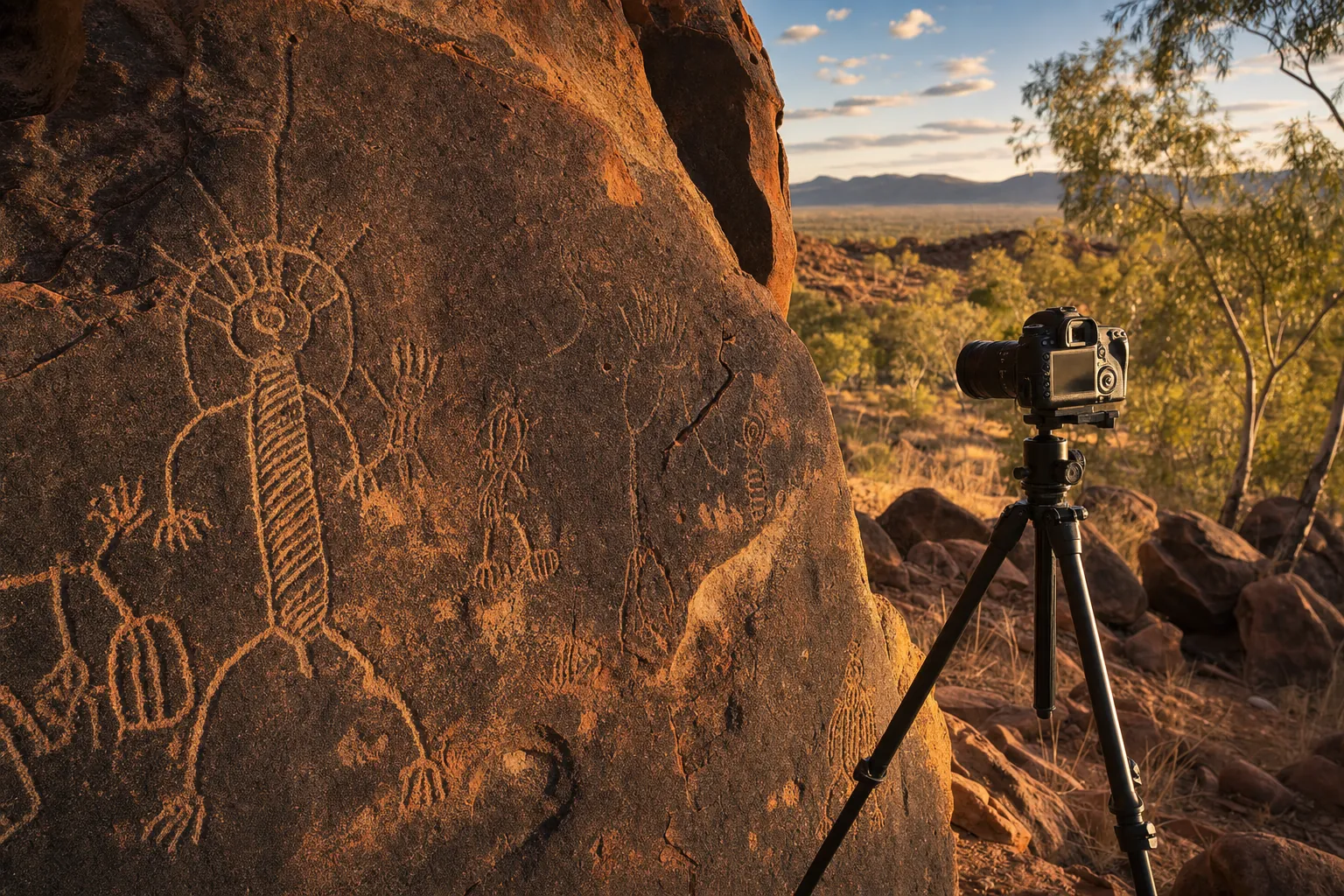
Digital Tools in the Service of Self-Determination
The preservation of First Nations cultural heritage is inseparable from questions of sovereignty and self-determination. For much of the 20th century, Australian institutions collected, classified, and controlled Aboriginal and Torres Strait Islander cultural material on institutional terms, often without meaningful consent from source communities. Digital technologies — when deployed under community governance — offer a different model: tools that communities can direct toward their own preservation, sharing, and revitalisation priorities.
The Australian Institute of Aboriginal and Torres Strait Islander Studies (AIATSIS) holds one of the world's largest collections of First Nations cultural material, including recordings, photographs, film, and manuscripts. Its work over the past two decades has progressively shifted toward community-controlled access frameworks, with AIATSIS's digital systems now allowing source communities to determine who can see specific items and under what conditions.
Language Revitalisation and Digital Archives
Australia is home to hundreds of distinct Aboriginal and Torres Strait Islander languages, but only a small number are still spoken fluently by significant numbers of people. The majority are critically endangered, with knowledge concentrated in elderly speakers. Digital recording and archiving has become a central strategy for documenting these languages before the last fluent speakers pass.
The PARADISEC (Pacific and Regional Archive for Digital Sources in Endangered Cultures) project, led by universities across the Asia-Pacific region, has digitised thousands of hours of field recordings made by linguists and anthropologists from the mid-20th century onward. Making these recordings accessible to descendant communities — many of whom had never known that recordings of their grandparents' generation existed — has catalysed new language learning and revitalisation efforts across Australia.
Community-based language centres, including the First Languages Australia network, are developing digital tools specifically designed for non-specialist use. Mobile apps that teach vocabulary through gamified interaction, augmented reality tools that overlay language labels on everyday objects, and community-managed online dictionaries are all in active development and deployment.
Community-Controlled Digital Infrastructure
A critical shift in Indigenous digital heritage work is the move away from dependence on mainstream institutional platforms toward community-controlled infrastructure. When cultural material is held in external databases — even with access restrictions — communities are ultimately subject to the governance decisions and financial sustainability of the hosting institution. Community-controlled repositories change this equation.
Mukurtu CMS — an open-source content management system designed specifically for Indigenous cultural archives — implements traditional knowledge protocols at the database level. Communities can assign specific cultural protocols to items, restricting access to particular gender groups, age groups, or ceremony participants, and these restrictions are enforced by the system architecture rather than relying on individual user compliance.
The Keeping Culture programme, operated through various state library partnerships, has supported First Nations community organisations to establish their own digital repositories and digitise material held locally — family photographs, community records, recordings made on personal devices — that would never find its way into formal institutional collections.
Repatriation and Digital Surrogates
Thousands of Aboriginal and Torres Strait Islander cultural objects are held in Australian and international museum collections. Physical repatriation — the return of objects to source communities — has gained significant momentum over the past two decades, driven by AIATSIS policy frameworks and bilateral agreements between Australian institutions and overseas museums.
Digital documentation plays a complex role in repatriation processes. High-resolution 3D scans and photography create surrogates that allow institutions to retain research access after physical return. More controversially, some communities have accepted digital surrogates as an interim measure when immediate physical repatriation is not possible. The ethics of this arrangement are actively debated: does a digital surrogate genuinely serve community interests, or does it provide institutions with a justification for indefinite retention of physical objects?
The Ara Irititja project in South Australia — which has worked to return digitised records to Anangu communities — demonstrates that the community perspective is not uniform. Some elders value digital surrogates highly, seeing them as tools for reconnection with ancestors. Others are clear that digital copies are not substitutes for physical objects that carry spiritual and relational dimensions beyond their material form.
Country, Mapping, and Land Knowledge
Traditional ecological knowledge and deep familiarity with country — accumulated over tens of thousands of years — represents a form of heritage that is inseparable from living cultural practice. Digital technologies are increasingly being deployed to record, transmit, and protect this knowledge.
Community-based participatory mapping projects have produced digital representations of country that integrate Aboriginal and Torres Strait Islander spatial knowledge with satellite imagery, environmental monitoring data, and historical records. These maps serve multiple purposes: supporting native title claims, informing land management decisions, and creating resources for younger generations to connect with country they may not have visited.
Geographic information systems (GIS) and custom web mapping platforms are the primary tools for this work. Projects like the Indigenous Protected Areas mapping programme and various state-based caring for country initiatives have produced publicly accessible digital resources that document ecological knowledge alongside cultural and historical information.
Protocols, Consent, and the Limits of Openness
The open data and open access movements that have gained traction across research and cultural institutions are not universally applicable to First Nations heritage. Some knowledge is sacred, secret, or restricted by gender, age, or ceremonial status. Some material was recorded without meaningful consent, and its continued circulation causes harm to communities of origin.
Local Contexts — a project developed by researchers at New York University and widely adopted by Australian institutions — offers an alternative to binary open/closed access frameworks. Its Traditional Knowledge (TK) Labels and Biocultural (BC) Labels allow communities to attach nuanced usage notices to digitised material: specifying who may view it, how it may be used, and what cultural obligations accompany access.
AIATSIS has developed its own metadata framework — the AIATSIS Subject Thesaurus and Cultural Materials Protocols — that provides vocabulary for describing First Nations cultural material in terms that reflect Indigenous knowledge categories rather than imposing Western classificatory frameworks.
Looking Forward
Artificial intelligence presents both opportunities and risks for Indigenous digital heritage. Machine learning models trained on images of cultural objects could facilitate identification and cataloguing at scale — but training data drawn from institutional collections without community consent risks perpetuating historical violations of cultural intellectual property.
The emerging field of Indigenous data sovereignty — articulated in Australia through the AIATSIS Code of Ethics and internationally through the CARE Principles for Indigenous Data Governance — provides a framework for ensuring that technological developments serve First Nations interests rather than repeating colonial patterns of extraction. As digital infrastructure becomes more central to cultural heritage preservation globally, ensuring that this infrastructure is genuinely available to and controlled by the communities whose heritage it holds is among the sector's most important challenges.