What Is Virtual Heritage?
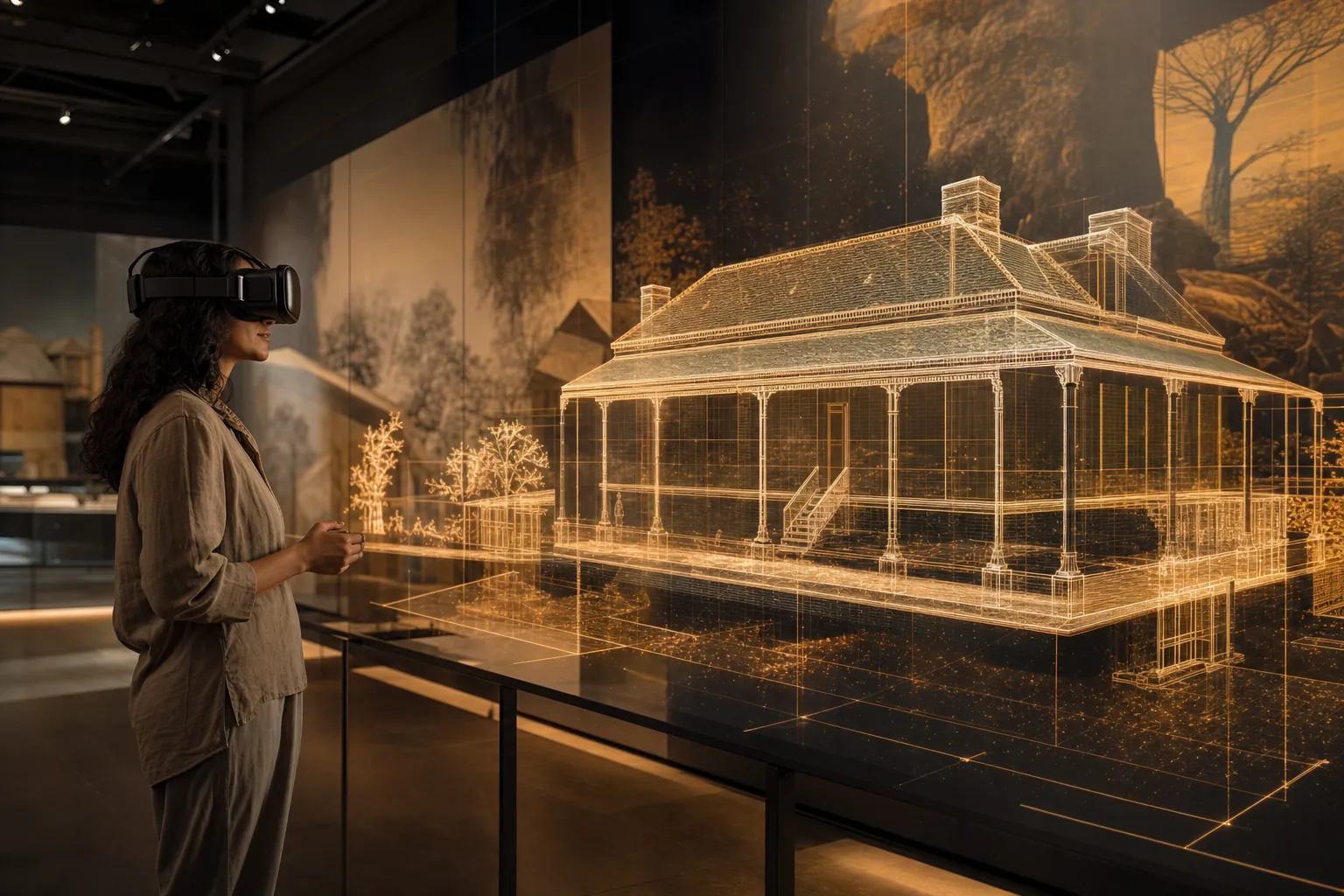
Virtual heritage refers to the application of digital technologies — virtual reality (VR), augmented reality (AR), mixed reality (MR), and interactive 3D visualisation — to the representation, interpretation, and communication of cultural and natural heritage. The field sits at the intersection of computer science, archaeology, museum studies, and interaction design.
Early virtual heritage projects in the 1990s produced static rendered images of reconstructed historic environments. Today, real-time game engines, head-mounted displays, and web-based 3D platforms make it possible to deliver compelling, interactive experiences to audiences on mobile devices, in purpose-built museum installations, and across the open web.
VR Reconstructions of Historic Sites
Some of the most powerful applications of virtual heritage in Australia involve digital reconstructions of sites that have been destroyed, significantly altered, or that are physically inaccessible to most visitors.
The Museum of Sydney's "Edge of the Trees" installation and related digital projects have used photorealistic 3D reconstruction to evoke the Gadigal country at the moment of European contact, layering Aboriginal oral history alongside colonial visual records. These reconstructions are not mere architectural replicas: they are interpretive arguments about contested history, made tangible through spatial experience.
Port Arthur Historic Site in Tasmania has deployed VR experiences that allow visitors to explore convict-era buildings as they appeared in the 1840s, overlaid on the partially ruined structures visible today. The temporal juxtaposition — moving between past and present within the same physical footprint — creates an interpretive power that conventional audio guides and signage cannot match.
Augmented Reality in Gallery and Museum Contexts
Augmented reality extends the physical museum experience rather than replacing it. By pointing a smartphone or tablet at an object, surface, or marker, visitors can access additional layers of information: animations showing how a historical tool was used, 3D models that can be rotated and examined, or video content featuring community members speaking about the object's significance.
The National Museum of Australia's AR applications for its First Australians galleries allow visitors to hear language recordings, see country footage, and access elder testimonies associated with specific objects on display. These experiences are designed in close consultation with source communities, ensuring that the additional context reflects community priorities rather than institutional interpretation alone.
The challenge for AR in museum contexts is sustainability: applications developed for specific devices or operating system versions require ongoing maintenance as the technology evolves. Web-based AR frameworks — particularly those built on WebXR and ARKit/ARCore — are increasingly preferred for their lower long-term maintenance burden.
Remote and Online Heritage Experiences
Australia's geography makes physical access to heritage sites deeply unequal. Remote communities, school groups in regional areas, and international visitors who cannot travel all benefit from high-quality digital surrogates for heritage experiences.
Matterport-style 360-degree virtual tours are now standard for major heritage sites and galleries, allowing users to walk through spaces at their own pace from any web-connected device. These platforms support annotation, audio guides, and multimedia hotspots, creating experiences that rival on-site visits for informational richness if not physical immediacy.
The Australian War Memorial deployed a comprehensive virtual tour of its galleries during COVID-19 closure periods, recording a significant increase in engagement from regional Australians who had never visited the Canberra site. Post-pandemic usage data confirmed that digital audiences are not simply displaced physical visitors: they represent genuinely new audiences with different needs and behaviours.
Real-Time Game Engines in Heritage Visualisation
Unreal Engine and Unity — originally developed for commercial game production — have become standard tools in the virtual heritage practitioner's toolkit. Their real-time rendering capabilities, physically based materials, and mature development ecosystems make them suitable for producing interactive heritage visualisations that respond to user input.
Research groups at the University of Melbourne, Australian National University, and Curtin University have published virtual heritage projects built on these platforms, ranging from interactive explorations of Angkor Wat to reconstructions of colonial Melbourne streetscapes based on historical survey data.
The London Charter and Seville Principles — international guidelines for the use of computer-based visualisation in heritage contexts — provide a framework for documenting the assumptions, sources, and interpretive choices embedded in virtual reconstructions. Australian heritage practitioners have been active contributors to the refinement of these principles through UNESCO and ICOMOS working groups.
Challenges: Authenticity, Access, and Sustainability
Virtual heritage projects face persistent challenges around questions of authenticity. A digital reconstruction is necessarily an interpretation: it embeds choices about what is shown, what is left incomplete, and whose knowledge is represented. The risk of presenting speculative reconstructions as authoritative records of the past is well-documented in the heritage literature.
Best practice calls for transparency markers — visual or textual cues that indicate the confidence level associated with different elements of a reconstruction — and for robust documentation of source material and methodological choices. The Australian Institute for the Conservation of Cultural Material (AICCM) has developed guidelines for the documentation of digital heritage projects that address these requirements.
Technological obsolescence is another persistent concern. Hardware-dependent VR experiences created for headsets that are no longer manufactured, or applications built on frameworks that have since been deprecated, become inaccessible within a few years of their creation. The sector is developing strategies — including open formats, progressive enhancement, and modular architecture — to extend the usable lifespan of virtual heritage investments.
The Future of Virtual Heritage in Australia
Emerging technologies — including neural radiance fields (NeRFs) for rapid scene capture, spatial computing platforms such as Apple Vision Pro, and haptic interfaces for virtual object handling — will continue to expand the possibilities of virtual heritage. The most significant development over the coming decade, however, may be less technical than social: the gradual normalisation of community co-authorship in the creation of digital heritage experiences.
Projects that place First Nations knowledge custodians, regional communities, and descendant groups in the driver's seat of virtual heritage production — rather than treating them as consultants to institutional projects — are producing outcomes that are both more culturally valid and more resonant with diverse audiences. These collaborative models are redefining what it means for a heritage experience to be authoritative.