3D Scanning for Cultural Collections
Published 15 April 2026
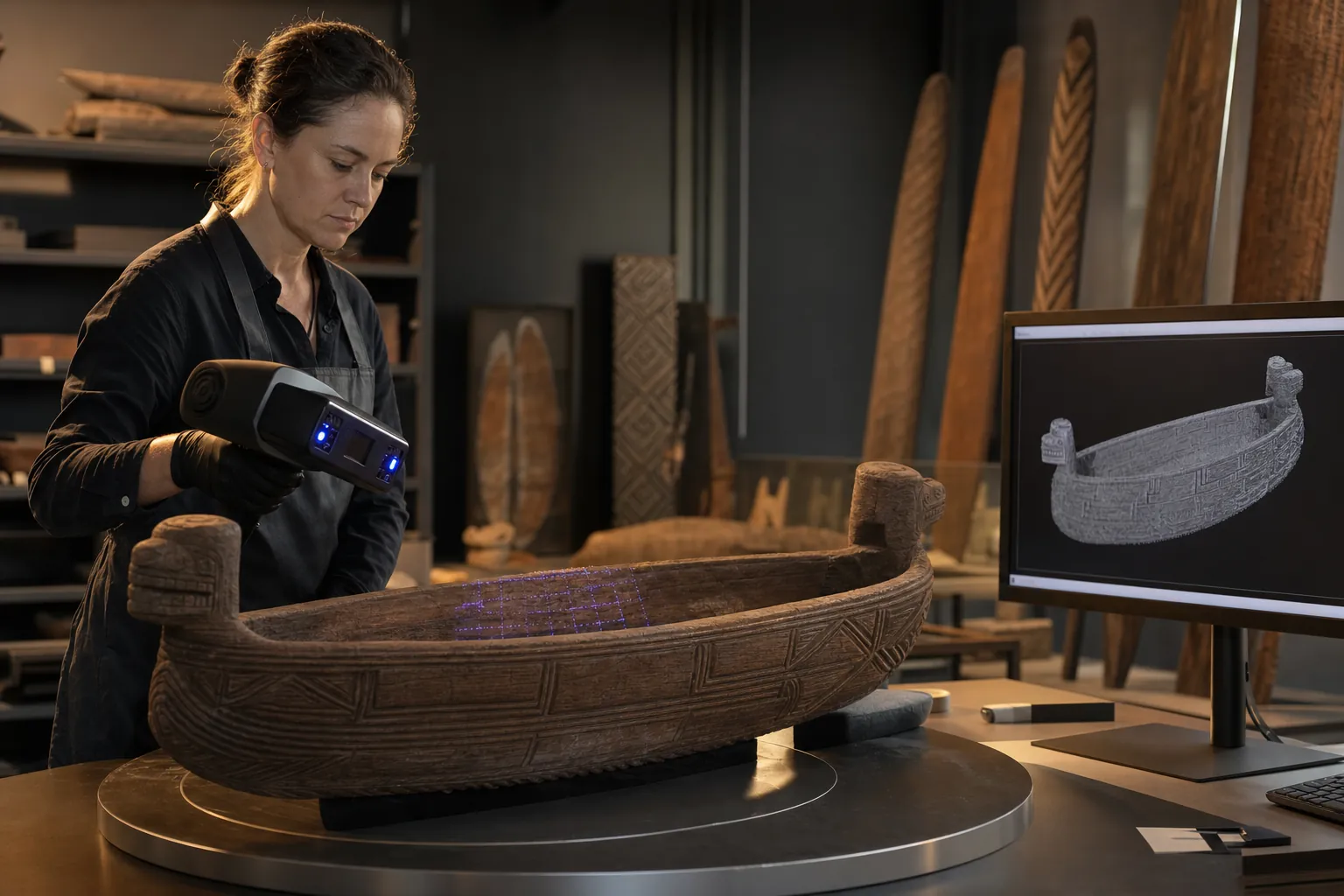
Three-dimensional scanning has moved from specialist research tool to routine museum practice over the past decade. As hardware costs have fallen and software has matured, Australian cultural institutions are now deploying structured light and laser scanning systems across collections that would previously have been documented only with flat photography.
How 3D Scanning Works
Structured light scanners project a known pattern — typically a grid or series of stripes — onto an object’s surface. A camera positioned at a fixed angle captures the way this pattern deforms as it follows the object’s contours. By computing the geometry implied by that deformation, the system produces a dense point cloud of surface coordinates with sub-millimetre accuracy.
Laser triangulation scanners work on a similar principle, substituting a laser stripe for the projected light pattern. Both technologies excel on objects with complex geometry — undercutting, organic curves, relief surfaces — that traditional photography and photogrammetry struggle to capture with equivalent precision.
For very large objects, including architectural elements and full-scale sculptures, terrestrial laser scanners (TLS) project a rotating laser beam across the scene and measure return times to produce point clouds of the entire environment.
What Australian Institutions Are Scanning
Museum Victoria’s natural history and social history collections have been a focus of intensive 3D documentation work. The museum’s digitisation team has produced publicly accessible 3D models of fossil specimens, historical scientific instruments, and cultural objects from Pacific and Indigenous Australian collections. These models are published through the museum’s online collection interface, allowing researchers to rotate, zoom, and examine objects remotely.
The Australian Museum in Sydney has integrated 3D scanning into its conservation workflows, using scans to monitor dimensional change in ethnographic objects and to plan treatment interventions on large wooden artefacts. Before stabilisation work, a baseline scan establishes the object’s geometry precisely; comparison scans after treatment verify dimensional stability.
Digital Models in Education and Outreach
Once a 3D model exists, its applications extend well beyond the institution that created it. WebGL-based viewers — including Sketchfab and Morphosource — allow institutions to embed interactive 3D models directly in web pages without requiring visitors to download specialised software. Students in regional schools can examine a replica-quality model of a colonial-era surveying instrument or an ancient stone tool on any device with a web browser.
The Smithsonian Institution’s open access model for 3D content — releasing scans of significant objects in the public domain — has influenced Australian thinking about how to maximise the educational reach of digitisation investments. Several Australian institutions are now releasing 3D data under Creative Commons licences, enabling derivative uses including 3D printing of physical replicas for tactile education programmes.
Challenges and Limitations
Not all surfaces scan well. Highly reflective materials — polished metals, glass, lacquered surfaces — can confuse structured light systems by scattering or absorbing the projected pattern unpredictably. Matte spray coatings can be applied temporarily to allow scanning, but this requires careful assessment of the object’s sensitivity and the reversibility of the coating.
Very dark surfaces present similar challenges, as they absorb the projected pattern rather than reflecting it clearly. Some practitioners address this with photometric stereo approaches that combine multiple images taken under different illumination conditions, but these require additional setup and processing time.
Storage and processing demands for large scan datasets are also significant. A high-resolution scan of a large sculpture can generate files of several gigabytes before any mesh processing or texture mapping. Institutions need to plan for both the computational infrastructure to process scan data and the long-term storage and preservation of the resulting assets.
Integration with Collection Management Systems
The practical value of 3D scans is significantly enhanced when they are linked directly to collection management records. Several Australian institutions have integrated their scanning workflows with platforms such as EMu (Electronic Museum), Vernon CMS, and CollectiveAccess, ensuring that scan files are associated with the correct object records, accessible through standard collection interfaces, and subject to the same access control and preservation policies as other digital assets.
This integration ensures that the 3D documentation produced during a digitisation project remains findable and usable over the long term, rather than accumulating in disconnected file systems where it becomes increasingly difficult to locate and interpret.