Virtual Museum Tours for Remote Audiences
Published 28 March 2026
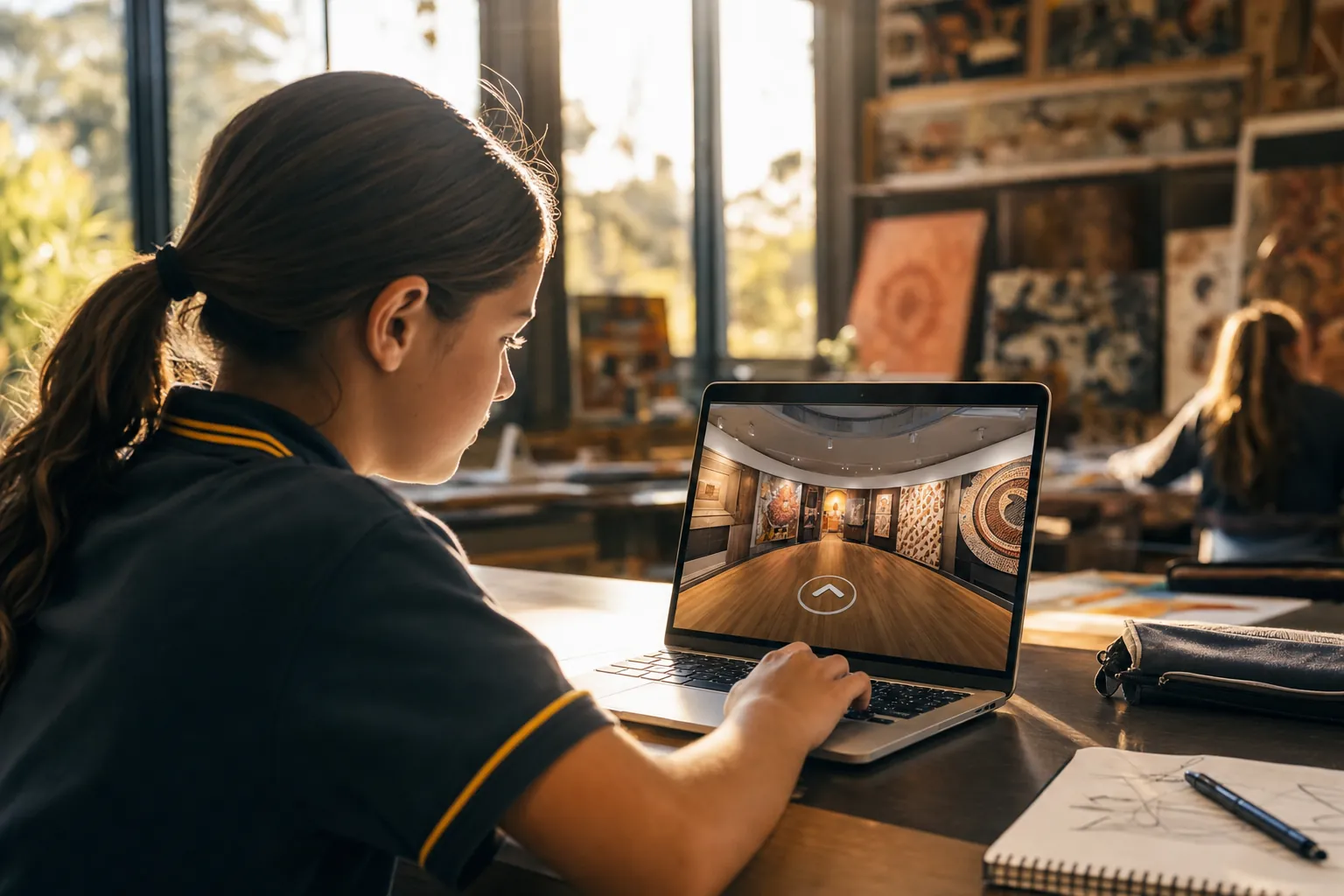
Australia’s vast geography has always created unequal access to cultural institutions. Major museums, galleries, and heritage sites are concentrated in capital cities; for Australians in regional and remote areas, a visit to the National Gallery of Australia or the Australian War Memorial often requires significant travel and expense. Virtual tours are reframing this access challenge — making collection experiences available to anyone with an internet connection.
The Technology Behind Virtual Tours
Modern virtual tours are built primarily on two technological foundations: 360-degree photography and photogrammetric reconstruction.
360-degree photography uses specialist cameras equipped with wide-angle lenses to capture spherical images of a space. Processing software stitches these images into seamless panoramas that viewers can pan through on any web browser or within a dedicated mobile application. The result is an immersive experience of a gallery space, allowing users to look in any direction and navigate between rooms by clicking on waypoints.
Photogrammetric reconstruction — the same technology used to digitise individual objects — can be applied at architectural scale to produce three-dimensional walkthroughs. By photographing a space exhaustively from many positions, practitioners can generate textured 3D models that users can move through freely, rather than being constrained to fixed viewpoints as in 360-degree photography.
Case Studies in Australian Institutions
The National Museum of Australia’s virtual tours, developed during gallery refurbishment periods and expanded through the COVID-19 closure period, allow users to explore gallery spaces and interact with multimedia content associated with displayed objects. Audio guides, video content featuring community members, and information panels are layered into the virtual environment, creating an experience with greater informational density than most physical visits.
The Powerhouse Museum’s online collection access, combined with virtual exhibition spaces, has been particularly significant for design and technology research communities outside Sydney. The museum’s collections include significant holdings in industrial design, fashion, and applied science that are of interest to researchers who may never visit the physical site.
State and territory museums have followed similar paths. Museum Victoria’s online collection platform integrates 3D models, archival imagery, and text resources alongside virtual tour components, creating a research-grade digital environment that extends well beyond simple room-walking functionality.
Accessibility Benefits
Virtual tours address physical accessibility barriers as well as geographic ones. For visitors with mobility limitations, chronic illness, or sensory disabilities, a physical museum visit may involve significant challenges that a well-designed virtual environment can reduce substantially.
High-quality virtual tours developed with accessibility in mind include keyboard navigation alternatives to mouse-based interaction, screen reader-compatible information architecture, and captioning for all audio content. The Web Content Accessibility Guidelines (WCAG 2.1) provide the benchmark for accessible virtual tour design, and several Australian institutions have made explicit WCAG compliance commitments for their digital audience programmes.
School Programmes and Curriculum Links
One of the clearest documented benefits of virtual museum tours in the Australian context is their uptake by regional schools for whom excursion visits are impractical. Platforms such as Google Arts & Culture have made it possible for schools anywhere in Australia to explore museum collections from any web-connected device, publishing high-resolution imagery and virtual tours from partner institutions worldwide. A school in outback Queensland or a remote community school in the Northern Territory can use a virtual museum tour as a core component of history, science, or Indigenous studies curriculum delivery in ways that would not otherwise be possible.
The integration of virtual tours into curriculum-aligned educational programmes — with lesson plans, student worksheets, and teacher guides designed to accompany virtual visits — has been a priority for several Australian museums. The Australian War Memorial and National Gallery of Australia both publish curriculum-aligned virtual learning programmes through their websites, with resources mapped to Australian Curriculum content descriptions.
Limitations and the Value of Physical Visits
Virtual tours, however well-executed, do not fully replicate the experience of a physical visit. The spatial scale of a gallery, the presence of other visitors, the proximity to original objects, and the sensory dimensions of a physical environment — sound, temperature, smell — are not reproducible in a digital medium.
Practitioners in the field are consistent in noting that virtual tours function best as complements to physical visits, not substitutes: they can preview collections for potential visitors, extend the reach of exhibitions to non-attending audiences, and provide ongoing access to collection experiences after physical exhibitions close. The goal is an expanded audience, not a digital replacement for the irreplaceable experience of encountering cultural objects in person.